Gallery 01 · Stone, light & completion
Giza reborn.
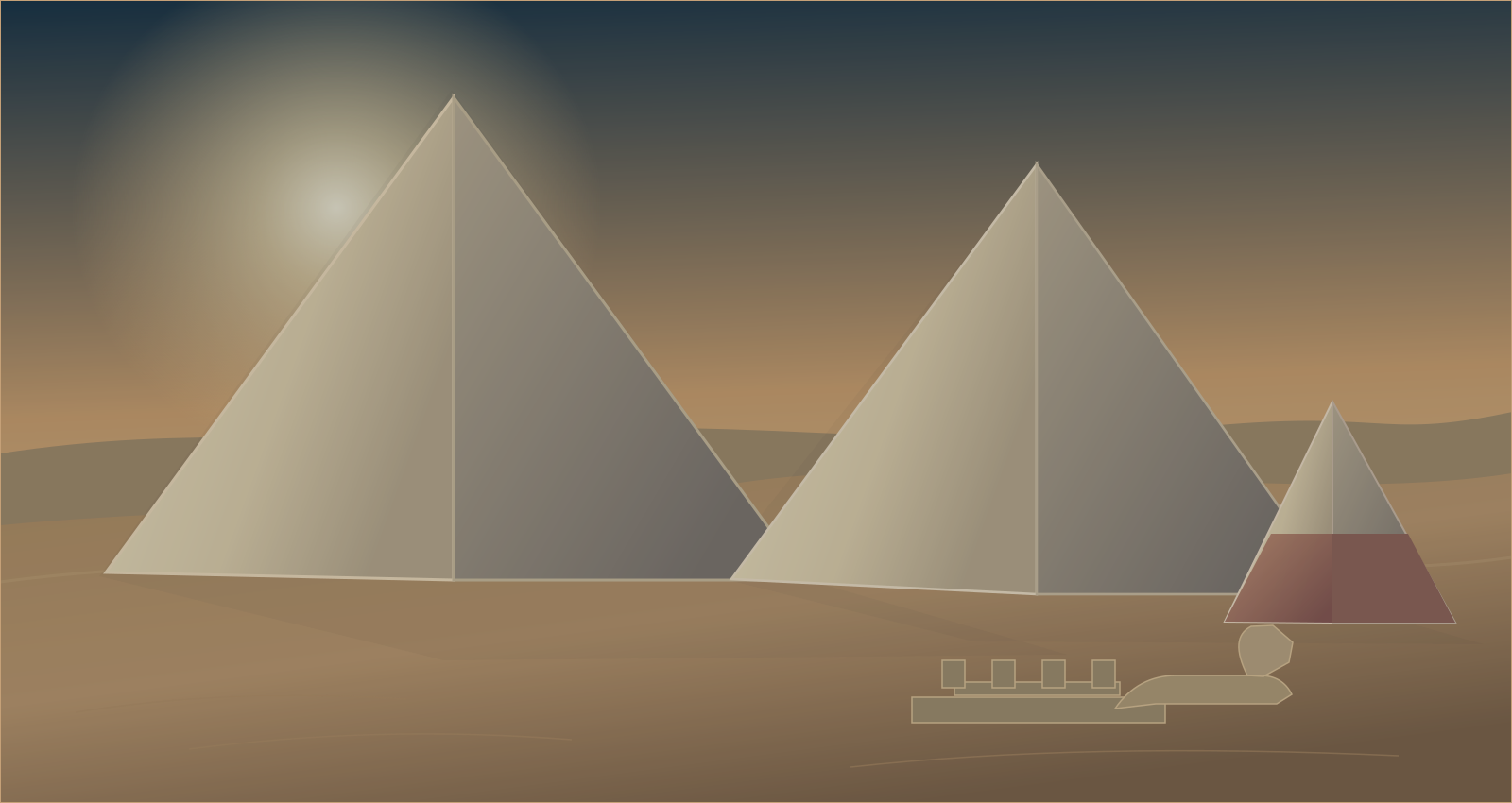
Imagine the plateau around 2500 BCE, after the three major Fourth Dynasty pyramids had been built. Their exterior surfaces were not the rough exposed core stone we see today.
Explore the materials
What made the pyramids shine?
Then
Smoothed stone faces
The Great Pyramid’s local limestone core was enclosed with fine white Tura limestone. Khafre’s pyramid still retains casing near its apex. Menkaure’s lower courses used Aswan granite.
Great Pyramid ↗ · Khafre complex ↗ · Old Kingdom materials ↗
Now
The surviving archaeological landscape
Loss of casing exposes the masonry underneath. Temples, causeways, smaller tombs, and boat-related structures remind us that a pyramid was only one part of a much larger royal mortuary complex.
Cross-check the reconstruction
Walk the 3D Giza archive.
Harvard’s Giza Project has research-backed models and an extensive collection of excavation photographs, maps and archaeological documents. Its virtual reconstructions can help visitors interrogate ours.
Explore Digital Giza ↗What we haven't resolved
We should not invent exact original coloration of every temple wall, missing statuary, or the pyramid capstones. We also should not suggest all three complexes were built simultaneously.